
In 2025, Independent Development Evaluation (IDEV) continued to support the African Development Bank (AfDB or “The Bank”) by generating independent evaluative evidence to inform strategic and operational decision-making and support organizational learning and accountability. The year marked an important phase of institutional transition and strategic renewal for the Bank, following the election and assumption of office of its ninth President, Dr. Sidi Ould Tah, and a sharpened focus on delivery, capital mobilization, and development impact.
|
|
In a context of heightened global uncertainty, tightening fiscal space, and rising expectations for development results, IDEV implemented the first year of its 2025-2027 Work Program, aligned with the Bank’s Ten-Year Strategy 2024-2033 and provided timely insights into what has worked well, what has not, and why, supporting learning and evidence informed decision making across the Bank and its Regional Member countries. A significant share of the evaluations conducted in 2025 examined how institutional reforms and corporate frameworks affect the Bank’s performance, generating evidence on how Bank-wide approaches, internal systems, and staff incentives shape both implementation effectiveness and development results. |
Evaluations delivered in 2025
In 2025, IDEV delivered 13 evaluation products across corporate, thematic, country, regional, and project cluster levels. Overall, the portfolio contributed to strengthening institutional and operational efficiency and effectiveness, informing strategic choices, and supporting accountability.
Promoting evaluation use, learning, and partnerships
Beyond evaluation delivery, IDEV focused on promoting the use of evaluative evidence through targeted learning, partnerships, and capacity development activities. During the year, IDEV organized learning events and capitalization workshops for Bank staff, facilitating exchanges on findings from evaluations on Results-Based Financing, counterpart funding, policy dialogue, and the validation of the 2022-2023 Project Completion Reports and Expanded Supervision Reports.

|
At the institutional and country levels, IDEV supported evidence informed dialogue through a side event during the Bank Group Annual Meetings in Abidjan, focusing on the role of evaluation in unlocking Africa’s financial capital. At the country level, IDEV also organized a dissemination event in Tanzania on building health systems that deliver results, drawing on evidence from its impact evaluation of the Bank’s Support to Maternal Mortality Reduction Project. IDEV further strengthened collaboration with the United Nations Children’s Fund Regional Office for West and Central Africa through joint events, including a capacity-building workshop for Members of Parliament in Côte d’Ivoire on the use of artificial intelligence in public policy evaluation.
IDEV also contributed to peer learning within multilateral development institutions by participating in a learning event entitled “Financing Micro, Small and Medium Agro-Industrial Enterprises: Lessons from Evaluation”, organized by the Independent Office of Evaluation of the International Fund for Agricultural Development, where evaluative perspectives were shared on financing approaches for agro-industrial value chains. In addition, IDEV contributed to a knowledge-sharing webinar on the evaluation of the Islamic Development Bank Group’s Regional Cooperation and Integration Policy and Strategy implementation for the period 2019 - 2023, organized by the Independent Evaluation Department of the Islamic Development Bank Group, supporting cross-institutional learning on regional integration and policy implementation.
|
|
Throughout the year, IDEV engaged with key evaluation networks, including the African Evaluation Association, through its 25th anniversary and the launch of the National Evaluation Capacities Index in Africa; the Evaluation Platform for Regional African Development Institutions (EPRADI); Twende Mbele; and the African Parliamentarians’ Network on Development Evaluation, which convened its 10th Annual General Meeting in November 2025 in Casablanca and Laâyoune, Kingdom of Morocco . As part of its engagement with EPRADI, IDEV organized a knowledge-sharing event on best practices for Project Completion Reports and Expanded Supervision Reports for staff of the West African Development Bank and other EPRADI member institutions. |
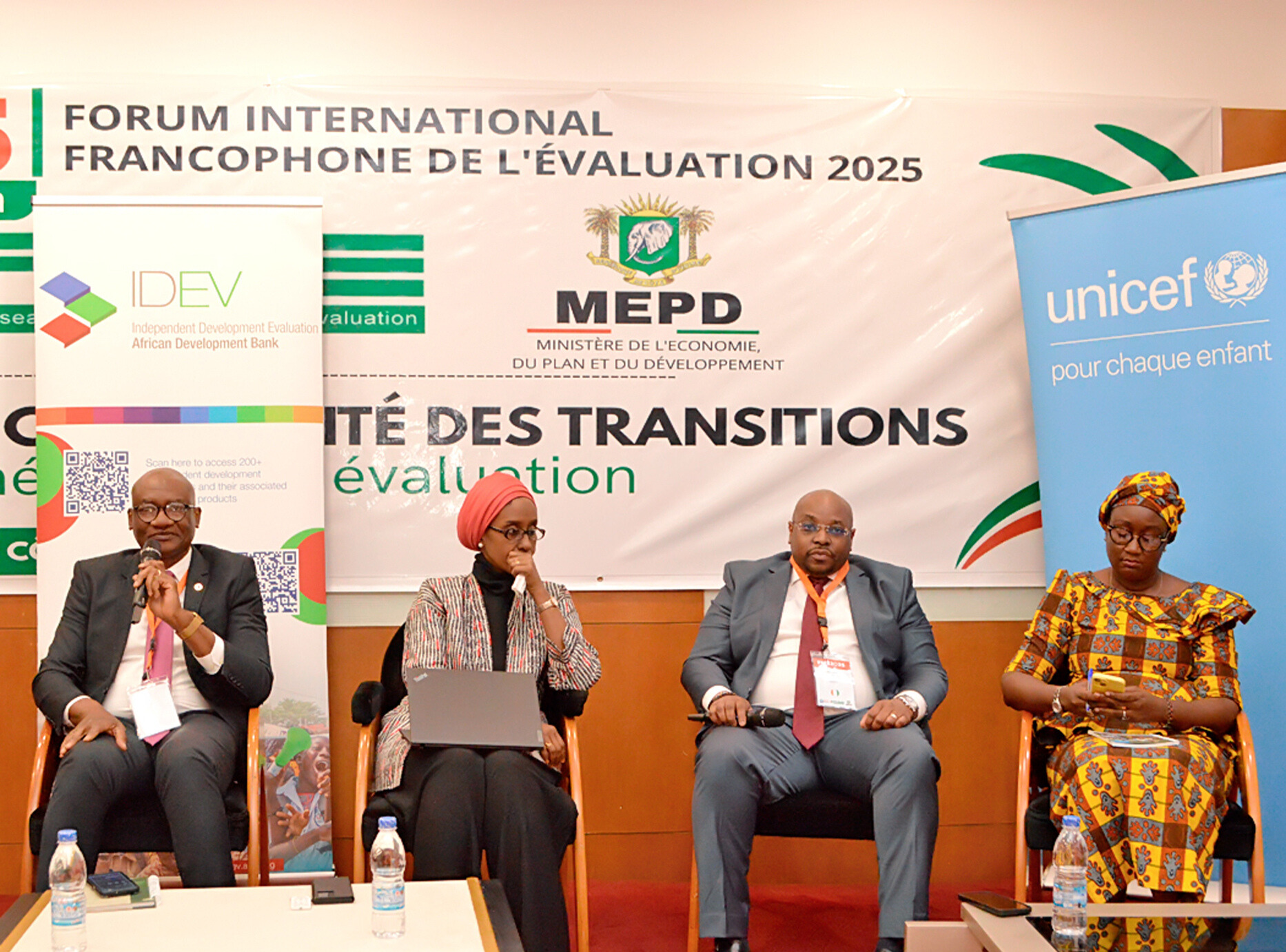
IDEV also contributed to learning events such as gLOCAL Evaluation Week, sharing experiences on sustainable growth, parliamentary evaluation culture, gender equality in transport, and evidence-based policymaking in polarized contexts, as well as the 2025 International Francophone Evaluation Forum.
Looking ahead
As the first year of the 2025-2027 Work Program, 2025 marked a phase of consolidation and adaptation to evolving institutional priorities. IDEV will present the results of its five institutional evaluations to Bank Management through an internal dissemination event, to inform and support ongoing institutional reforms. Looking ahead, IDEV will continue to deliver timely, credible, and policy-relevant evaluations aligned with the Bank’s priorities, supporting learning, accountability, and effective decision-making in pursuit of sustainable development results across Africa.