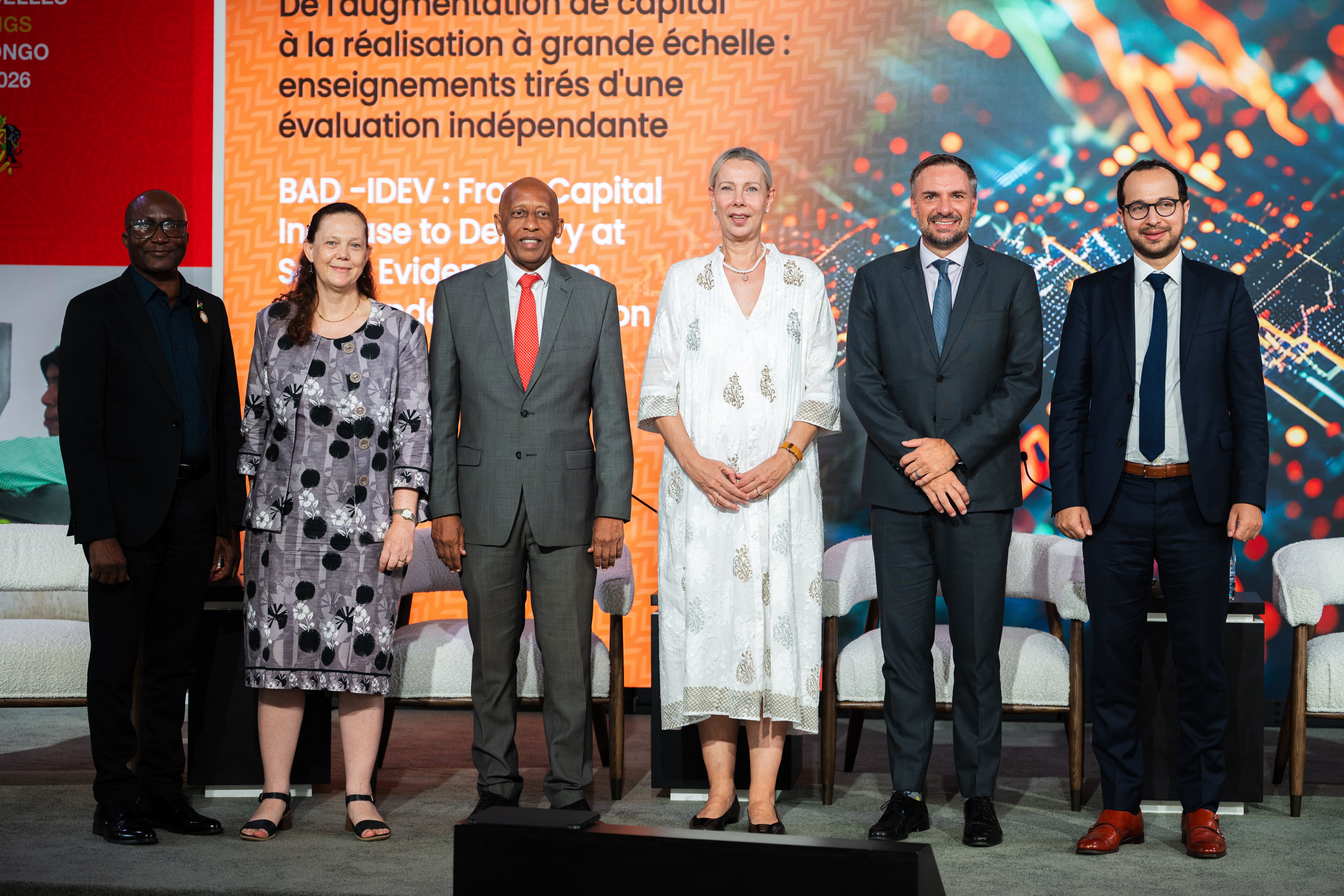
From left to right: Festus Nghifenwa (Director, Economic Policy Advisory Services, Ministry of Finance, Namibia), Karen Rot-Münstermann, (Evaluator General, IDEV/AfDB), Armand Nzeyimana (Director, Development Impact and Results Department, AfDB), Malinne Blomberg (Deputy Director General, North Africa Region, AfDB), Jon-Pierre Fourie (Senior Director, Strategy and Investor Relations, Africa50) and Omar Sefiani (Director, Treasury Department, AfDB).
Strengthening institutions, improving delivery capacity, and maintaining financial sustainability are essential to ensuring that increased development finance translates into measurable impact at scale. These were the key findings presented during a side event organised by the Independent Development Evaluation (IDEV) function of the African Development Bank (AfDB or “the Bank”), during the Bank’s 2026 Annual Meetings in Brazzaville. The session, titled “From Capital Increase to Delivery at Scale: Evidence from Independent Evaluation,” brought together policymakers, economists, and representatives from government and development finance experts to discuss the institutional and financial conditions required to convert mobilised development finance into sustainable development outcomes.
The discussion drew on findings from IDEV’s evaluation of the Implementation of the AfDB’s Commitments under the Seventh General Capital Increase (GCI VII). Approved in 2019, the GCI-VII more than doubled the Bank’s capital base from USD 93 billion to USD 208 billion and was accompanied by a broad range of institutional and operational reforms aimed at strengthening financial capacity, institutional effectiveness and responsiveness to Regional Member Countries (RMCs).
In her opening remarks, Karen Rot-Münstermann, Evaluator General of the AfDB, emphasised that scaling development finance requires more than capital expansion. She stressed that institutional strength, effective implementation systems, resource mobilisation, strategic partnerships, and financial sustainability are critical drivers of development impact. Rot-Münstermann noted that while the GCI-VII significantly strengthened the Bank’s financial position, translating this increased financial capacity into development results depends on strategic alignment with country priorities, institutional readiness and effective project implementation. Against the backdrop of widening financing gaps, rising debt pressures, and growing global uncertainty, she underscored the importance of evidence-based decision-making, “ evaluation evidence speaks to real development challenges and informs stronger institutional systems, improved delivery, and more effective development financing.” A panel discussion moderated by Armand Nzeyimana, Director of the Development Impact and Results Department at the AfDB, examined how institutions can strengthen the link between financial resources and development results.
Omar Sefiani, Director of AfDB’s Treasury Department highlighted efforts to maintain a strong financial position, including pursuing a standalone AAA credit profile. He noted the importance of optimising the credit quality of the loan portfolio and enhancing callable capital in line with recommendations under the G20 Capital Adequacy Framework. These measures, he explained, are essential for accessing low-cost funding and enabling the Bank to play a counter-cyclical role in supporting African economies.
Reflecting on IDEV’s findings regarding institutional readiness and implementation capacity, Malinne Blomberg, Deputy Director General for the North Africa region and Country Manager for Tunisia, Libya, and Mauritania at the AfDB pointed out persistent gaps in project readiness, execution capacity, and country ownership as key constraints to effective delivery, and institutional readiness.
She emphasised the need for closer collaboration between the Bank and RMCs to prepare investment-ready projects, and suggested the use of implementing agencies, including United Nations organisations, as one of the approaches to accelerate execution. Blomberg also stressed the importance of clearly defining development priorities and coordination among development partners to optimise resource allocation and delivery.
Speaking from the country level perspective, Festus Nghifenwa, Director for Economic Policy Advisory Services at Namibia’s Ministry of Finance, identified political stability, good governance, accountability and policy alignment as key enablers for successful project implementation. He further stressed the need to strengthen country ownership, public policy and governance frameworks.
Representing Africa50, Jon-Pierre Fourie, Senior Director for Strategy and Investor Relations, shared approaches to address project preparation and financial bottlenecks. He highlighted the importance of early-stage project development, de-risking mechanisms, innovative financing solutions, and asset recycling as practical tools to accelerate project readiness, mobilise private capital, and support investment in infrastructure across the continent.
The panelists underscored the need for integrated approaches that combine financial strength with institutional capability. They concluded that maintaining robust credit ratings to access affordable funding, strengthening governance frameworks, improving project preparation, and enhancing policy alignment are important factors to scale development impact.