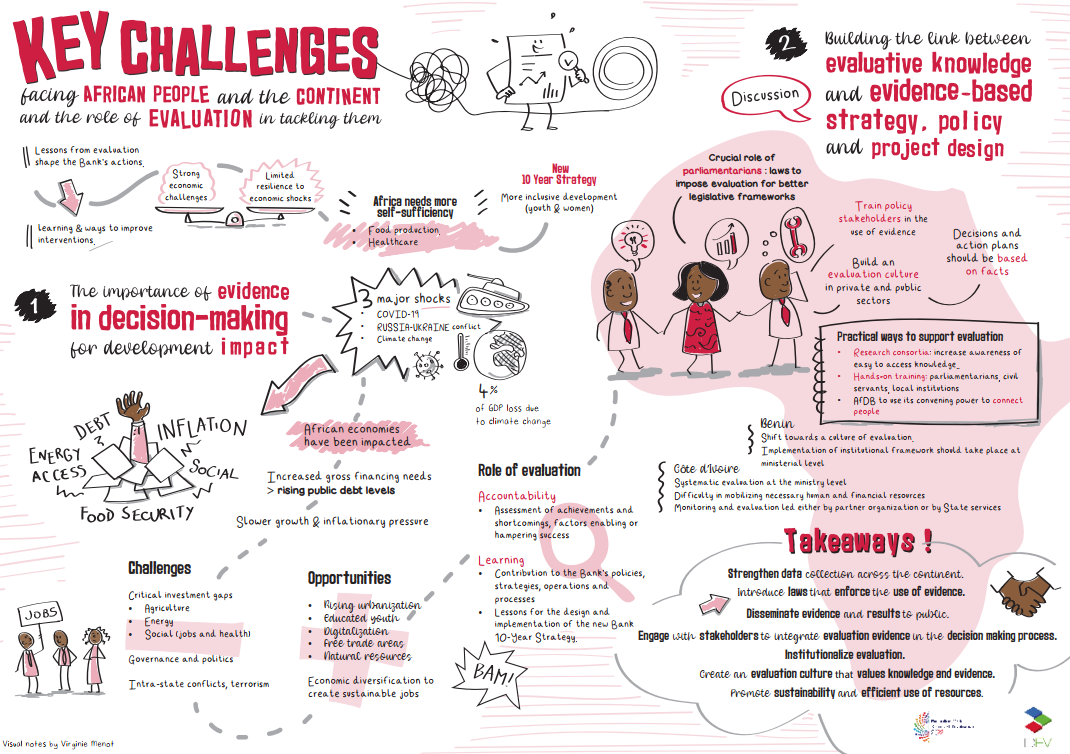
The opening session of the 2022 Development Evaluation Week attracted thought leaders and experts from international development institutions, academia, and governments, who set the tone for the next three days of discussions and knowledge sharing. The participants were provided with an overview of some of the critical challenges facing Africa before a panel discussion on the role of evaluation in tackling them.
In her welcoming remarks, Karen Rot-Münstermann, the AfDB Evaluator General, highlighted the importance of the relationship between development decisions for the future and lessons from the past. She noted that as the Bank develops its new Ten-Year Strategy, IDEV is ready to provide evaluative knowledge to harness the Bank’s knowledge capital to achieve its ambitions. Evaluation Week is one of the means of sharing knowledge in a collaborative and constructive manner, as such discussions can contribute to transformation in the development space.
Speaking on behalf of the AfDB President, Dr. Akinwumi Adesina, Simon Mizrahi, Acting Vice President for Technology and Corporate Services, AfDB, affirmed President Adesina's deep commitment to learning from evaluations and to advancing the independent nature of the Bank's evaluation function. Acting VP Mizrahi provided the participants with three things to reflect upon during the next few days of knowledge-sharing and learning:
First, learning from success. A simple repeat of the same input may not result in a win the next time around, so it is important to examine and identify the factors that contributed to the success and whether these factors can be replicated in other situations.
Second, having the courage to admit failure and draw lessons from those experiences; and thirdly, by speaking up, expressing our ideas, and sharing our knowledge during the Evaluation Week.
The opening address was followed by a keynote presentation by Walter Odhiambo, Lead Strategy Advisor, Corporate Strategy and Policy Department, AfDB, on Africa's current development challenges and the role of evaluation evidence in developing the Bank's new Ten-Year Strategy. Mr. Odhiambo began by describing the backdrop of economic shocks triggered by COVID-19, the Russia-Ukraine crisis, and the climate crisis that impacted African economies. As public debt levels have risen, investment gaps in critical infrastructure have widened. Therefore, economic recovery is imperative for sustained development. Mr. Odhiambo noted that climate change represents Africa's biggest development threat. The United Nations Environment Program estimates that, since 2020, Africa has been losing US$7-15 billion each year as a result of climate change, and this is predicted to rise to US$50 billion per year by 2030. Looking ahead, the African Continental Free Trade Area provides new growth opportunities. Economic diversification and unleashing the private sector will be key to successful economic recovery, as will be creating sustainable jobs and livelihoods in view of achieving the UN Sustainable Development Goals.
Mr. Odhiambo stressed the importance of evidence-based decision-making, reiterating that policy outcomes and evaluation have informed new policy designs while taking into account the capacity to implement these new policies.
Panel discussion: The use of evaluation to build a stronger and more resilient Africa
After the key trends and challenges for Africa were laid out, the stage was set for a discussion on the use of evaluation and evidence-based decision-making as a necessary pathway to tackling Africa's challenges and building a more resilient continent. Niels Breyer, Executive Director and Chair of the Committee on Operations and Development Effectiveness, AfDB, moderated the panel discussion and asked the panelists to reflect on the role of evaluation in achieving better development results. He specifically asked the panelists to express their views on the following:
How can evaluation findings be better integrated in national strategies and policies?
Hon. Jérémie Adomahou, Member of Parliament for Benin and Chairman of the African Parliamentarians' Network on Development Evaluation (APNODE) affirmed that country leaders should explicitly put forward the willingness to incorporate evaluation evidence in national policies and strategies. In this respect, he argued, parliamentarians have an important role to play as they can deploy various means of legislating the agreed frameworks and approaches. He gave an example of the sanitation crisis in coastline cities, where a legislative framework could help avoid the challenges many African countries face. Hon. Adomahou spoke of the importance of the APNODE network in ensuring good governance and called for more support, especially from the AfDB, to increase the capacity of the parliamentarians in the network.
How are Governments building a culture of evaluation?
Yéo Nahoua, Chief of Staff at the Ministry of Planning and Development of Côte d'Ivoire, highlighted evaluation as a critical lever for development because it ensures transparency and learning. Systematic evaluation at the ministry level was the way forward, and he agreed that frameworks were important to ensuring this. Mr. Nahoua added that evaluations influence successive development planning in Côte d'Ivoire and the ministry is pursuing the drive to institutionalize the practice of evaluation. Mr. Nahoua noted that there is often a problem of consensus and that there should first be agreement on the evaluation process and methodology so there can be unanimity on its outcome. He also spoke of the difficulty in mobilizing the necessary human and financial resources at the ministry and project levels, despite the strong interest from policy-making stakeholders. He concluded that monitoring and evaluation could be led either by a partner organization commissioned by the State or by State services to make evaluations of projects systematic.
How can the AfDB support its member countries in building a culture of evaluation?
Mr. Odhiambo recommended that the Bank's strong evaluation culture and the capacity to generate evidence should also be deployed at the national level. The Bank should therefore increase its support for networks that conduct policy analysis, for example. One over-arching issue is climate change adaptation, where the Bank supports African countries in various ways, including by providing evaluation evidence.
How do other continents use evaluation evidence and how do they compare to Africa?
Fatema Soumar, Executive Director of the Center for International Development at the Harvard Kennedy School, noted that although a wealth of knowledge had been accumulated over several decades and is universally available, there is no silver bullet solution that can be applied across the globe. What differentiates continents and regions is the culture of evaluation and its practical use. The AfDB is a great convening power for connecting people across the African continent, which should be leveraged. Training is also essential at multiple levels, especially for young staff in local institutions, where staff does not change at the rhythm of elections.
Ms. Soumar affirmed that where the evaluation practice struggles to capture attention, a theory of change and a planned approach are insufficient to address this issue. Instead, "there is a need to value the knowledge gained from evaluation evidence and build a culture of evaluation at the local levels. Capacity-building programs for development practitioners on the ground are important tools in achieving this," said Ms. Soumar.
How can we refine the political system in a democratic and inclusive society like Benin?
Hon. Adomahou spoke of the institutional framework for evaluation in place in Benin, which is helping to reinforce the role of evaluation in the new national development plan. According to Hon. Adomahou, Benin has made headway towards building a culture of evaluation. However, he argued that the implementation of the institutional framework should now take place at the ministerial level.
What is the Bank's take on the challenges around sustainability?
Mr. Odhiambo concluded that the Bank had made a lot of progress on the issue of sustainability through the better design of interventions, adding that this is where evaluation has become very important. "Not only are we learning important lessons on how we have been able to perform in the past, […] but we are also getting evidence from stakeholders," said Mr. Odhiambo.
ED Breyer wrapped up the discussion with a summary focused on the importance of forging political will to institutionalize and use evaluation to inform political decisions. He concluded that a wide range of stakeholders are important in building a culture of evaluation.
Author(s)