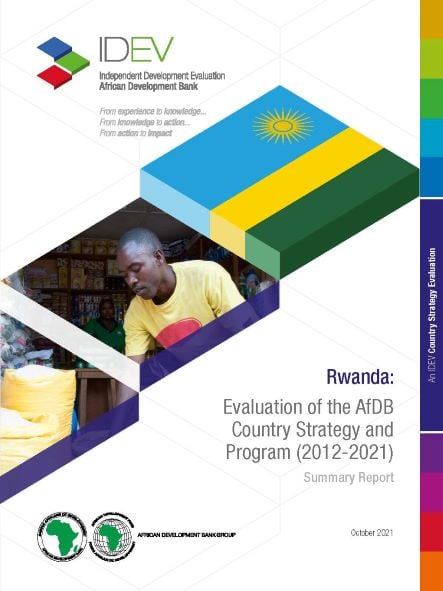
Independent Development Evaluation (IDEV) at the African Development Bank (AfDB) has carried out an evaluation of the AfDB's country strategy and program for Rwanda for the period 2012-2021. The evaluation covered two program cycles, 2012-2016 and 2017-2021, during which 37 projects totaling UA 1.2 billion (USD 1.7 billion – October 2021 exchange rates) were approved.
The purpose of the evaluation was to inform the design of the Bank's next country strategy for Rwanda (2022-2026). Its objectives were to: i) assess the contribution of the Bank to the development results of Rwanda; ii) identify the factors that enabled or hampered success and explain why this was the case; and iii) provide recommendations for future strategies and programs.
The evaluation found that the AfDB's interventions in Rwanda were highly relevant to the country's needs, development challenges, and priorities. It also found the coherence of the country strategies to be highly satisfactory, however, there was room for improvement in terms of proactive and continuous engagement with Development Partners.
In terms of effectiveness, the two country strategies were rated satisfactory. However, the evaluation found little evidence to show that the Bank’s support to enterprise development and Technical and Vocational Education and Training resulted in adequate skill development and job creation. Furthermore, the evaluation found that financial institutions benefiting from AfDB lines of credit did not appropriately target end-beneficiaries, notably small and medium-sized enterprises.
The evaluation assessed the sustainability of benefits of Bank support as partly unsatisfactory, largely due to insufficient revenue-generating capacity in the water and sanitation sector, non cost-recovering electricity tariffs, and shortfalls in the maintenance budget for road infrastructure. Overall, the evaluation rated the efficiency of the Bank support as satisfactory, despite frequent delays in infrastructure projects due to procurement challenges.
The evaluation drew a number of lessons to inform the Bank’s future engagement in Rwanda and in similar situations.
Key recommendations of the evaluation to the Bank included:
- Maintain a focus on key sectors while improving selectivity in its support to the country. The Bank should continue its support to transport, water supply and sanitation, and energy. It should also strike a balance between the “hard” and “soft” components of support (including dialogue and knowledge products) while ensuring the appropriate sequencing of interventions to address implementation capacy weaknesses.
- Sharpen the strategy and approach to private sector development by making it more coherent and comprehensive. The Bank should carefully define the areas of its private sector agenda ensure synergy with the interventions of other development partners. Any Lines of Credit project should ensure careful targeting of enterprises and be combined with capacity building for the participating financial institutions so that they are able to better address the needs of the Micro, Small & Medium Enterprises.
- Ensure the sustainability of the long-term benefits of infrastructure projects. The Bank should engage the government in policy dialogue to address tariff issues in the energy and water supply and sanitation sectors, and earmark adequate budget for the maintenance of road infrastructure. It should also support policy and institutional reforms to ensure sustainability of development results.
The Task Manager for this evaluation was Girma Earo Kumbi, Chief Evaluation Officer.
| Attachment | Size |
|---|---|
| Rwanda CSP Evaluation - Summary Report | 3.25 MB |
| Rwanda CSP Evaluation - Executive Summary | 341.39 KB |
| Rwanda CSPE Inception Report | 6.11 MB |